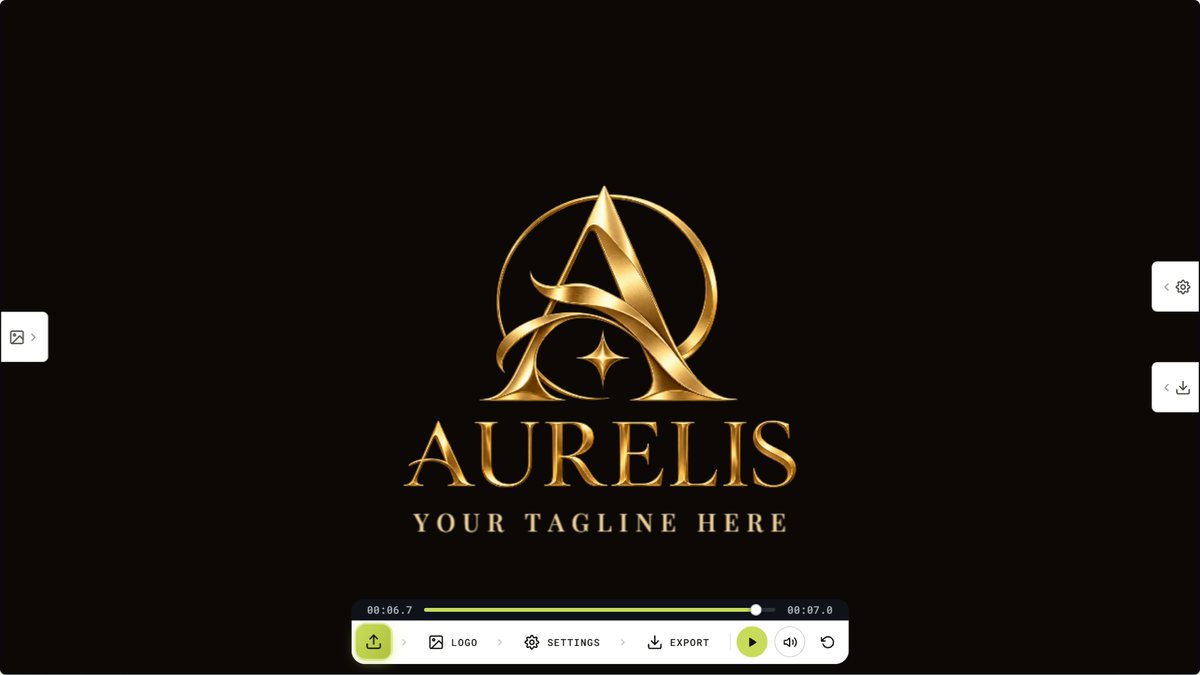
You can make a 3D logo animation for free, without installing any software, using a browser-based tool. Upload your logo (or type text), extrude it into a solid 3D object, pick a material like gold or chrome, choose an animation, then export it as a video, GIF or 3D file. The whole process takes two to three minutes and needs no Blender, After Effects or design experience.
This guide explains exactly how it works, which settings to use, and how to export for wherever your logo needs to go.
What is 3D logo animation?
3D logo animation is the process of giving a flat (2D) logo real depth and motion: extruding it into a three-dimensional object that can rotate, catch light on metallic or glass surfaces, and move through space. Unlike a simple 2D animation that moves a flat image, a 3D logo animation renders the logo as a solid object with thickness, bevelled edges, materials and lighting, then animates it and exports a video or 3D model.
How to make a 3D logo animation for free (4 steps)
To make a 3D logo animation for free in your browser, use the 3D Logo Animator and follow these four steps:
- Add your logo or text. Upload a transparent PNG or SVG, or type a word, it becomes 3D instantly. Adjust the depth and bevel to set how thick and rounded the edges are.
- Pick a material. Choose from 45 materials including gold, chrome, copper, rose gold, glass, diamond, ruby, emerald, marble, carbon, holographic, iridescent and neon.
- Choose an animation. Select one of 68 animations: from clean rotations (Rotate Y, Spin All, Coin Flip) to physics moves (Bounce, Jelly, Wobble) to camera moves (Orbit, Dolly, Crane) and reveals (Assemble, Explode, Cascade).
- Light it and export. Set the lighting and background, then export a seamless 1080p loop: transparent WebM or green-screen MP4, or the 3D model as a GLB or STL file.
Everything renders live in your browser and nothing uploads to a server, so your logo stays private.
Which material should you choose?
Match the material to your brand: gold, chrome, copper and rose gold read as premium and luxurious; glass, holographic and iridescent feel modern and tech-forward; matte, carbon and metal look understated and professional. The 3D Logo Animator offers 45 materials in total, so the fastest approach is to try three or four and compare: switching materials is instant and updates the live preview.
Which animation looks best on a logo?
For most brands, a slow, simple motion looks the most polished. A gentle Rotate Y, Float or Levitate loop reads as expensive and works well as a repeating background element. Save dramatic moves like Explode, Assemble or Tumble for one-time intros, where the reveal has impact. Frantic, fast animation tends to look cheap: when in doubt, slow it down. The tool includes 68 animations covering rotations, physics-based motion, camera moves and reveals.
Video or 3D file? Choosing the right export format
Export a video (WebM or MP4) if the logo is going into a video, website or social post; export a 3D file (GLB or STL) if it is going into a game engine, AR experience or 3D printer. Here is what each format is for:
- Transparent WebM : a video with a real alpha channel that drops onto any background in Premiere, DaVinci Resolve, CapCut and OBS. Best for overlays and edits.
- Green-screen MP4 : for editors that cannot read WebM transparency, since MP4 cannot store an alpha channel. Key out the green in your editor.
- GLB : the 3D object itself, for game engines, augmented reality and web-3D.
- STL , a printable mesh for turning your logo into a physical 3D-printed object.
If you need a GIF instead: for an email signature or a chat app. Export the video and run it through our free GIF Compressor, which converts MP4 to GIF and shrinks the file.
Tips for a clean 3D logo result
- Simple logos extrude best. Bold shapes and thick strokes look great in 3D; very fine detail can get lost once it has depth and lighting.
- Keep the extrusion moderate. A little depth reads as premium; too much turns your mark into a chunky block.
- Match the material to the brand, not just to what looks flashy in the preview.
- Keep motion subtle for anything that loops, and save bold reveals for intros.
Where to use a 3D logo animation
- YouTube intros and outros , a spinning 3D mark instantly looks established.
- Website hero sections and loading screens , a slow floating loop draws the eye.
- Twitch and stream overlays , a transparent WebM in the corner adds motion without clutter.
- Social reels and ads , export vertical for stories.
- Products, AR and 3D printing : GLB and STL take the logo off the screen entirely.
Simpler alternatives
If you do not need full 3D control, two other free tools may suit you better. The 3D Logo Spin maker is a quicker, template-driven spinning-logo tool with 16 ready-made looks. The Logo Animator offers 120+ 2D animation effects with GIF and MP4 export, for when you want motion without depth.
Frequently asked questions
Can you make a 3D logo animation without software?
Yes. Browser-based tools like the 3D Logo Animator turn a 2D logo or text into an animated 3D object with no download or installation: everything runs in your web browser, and the rendering happens on your own device.
Do I need Blender or After Effects to animate a logo in 3D?
No. Blender and After Effects can produce 3D logo animations but have steep learning curves. A dedicated browser tool handles the extrusion, materials, lighting and animation automatically, so you can create a professional result in minutes without learning 3D software.
Is the 3D Logo Animator free?
Yes. It is free to use in your browser with no watermark on the tool, and you get free credits to export when you create an account. There is no software to buy and nothing to install.
Can I export a 3D logo as a transparent video?
Yes. Export it as a transparent WebM, which carries a real alpha channel and drops onto any background in editors like Premiere, DaVinci Resolve, CapCut and OBS. For editors that cannot read WebM transparency, export the green-screen MP4 instead and key out the green.
What file format is best for a 3D logo?
For video and web use, choose WebM or MP4. For game engines, AR or web-3D, export GLB. For 3D printing a physical version of your logo, export STL. If you need a GIF, convert the exported video with a free GIF converter.
How do I 3D print my logo?
Extrude your logo in the 3D Logo Animator and export it as an STL file, which is the standard mesh format that slicing software (like Cura or PrusaSlicer) uses to prepare a model for a 3D printer.
Summary
Making a 3D logo animation no longer requires expensive software or a motion designer. Upload or type your logo, extrude it, pick from 45 materials and 68 animations, and export a video, GIF or 3D file: free, in your browser, with no watermark on the tool. Keep the shape bold and the motion calm, and the result will look far more expensive than it was to make.